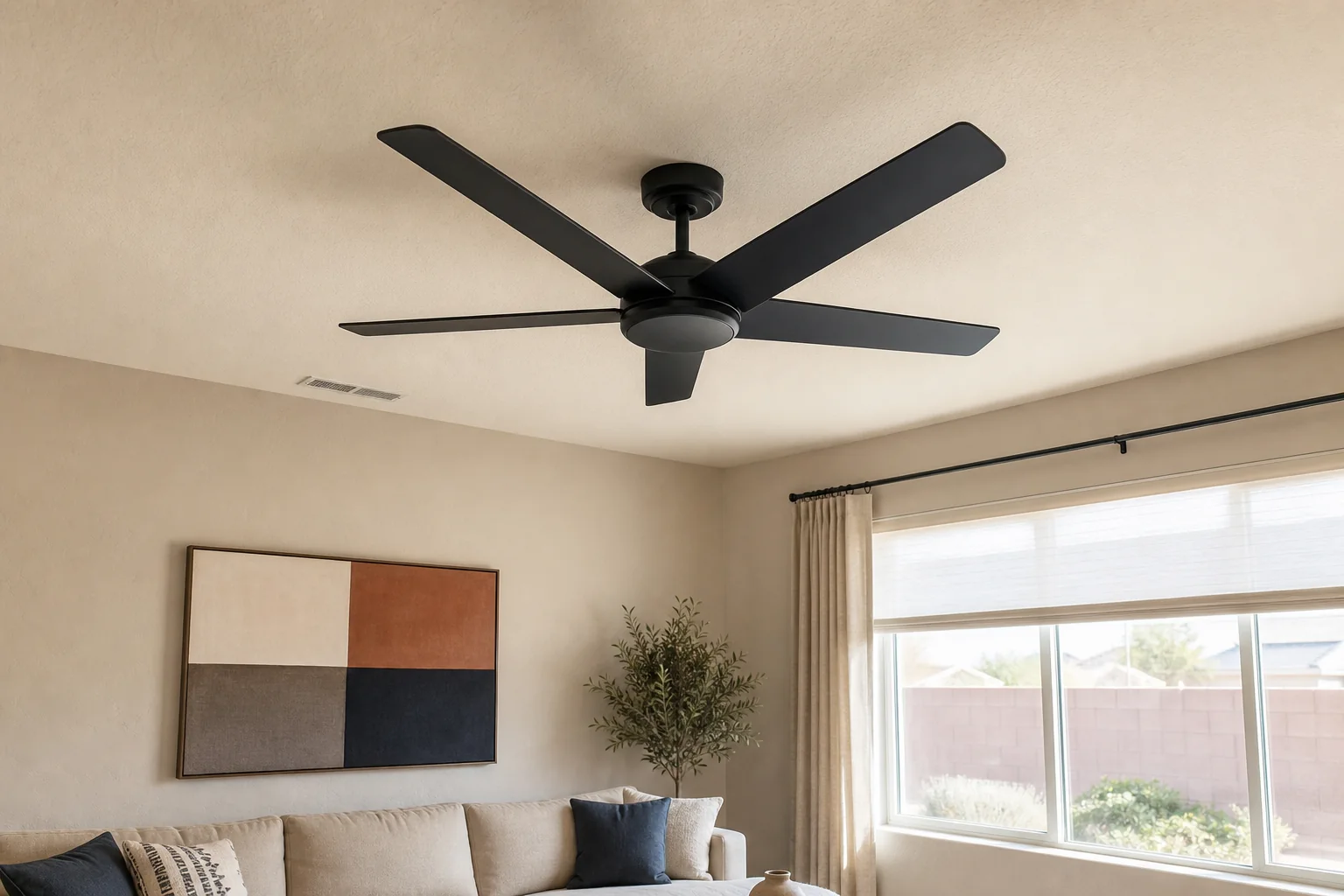
Can a ceiling fan lower the room temperature?
No. A ceiling fan moves air across your skin, which can make an occupied room feel more comfortable. It does not lower the room's actual temperature, so running a fan in an empty room does not cool the house.
That distinction matters in Phoenix. A fan may let you stay comfortable with less aggressive air-conditioning settings, but the result depends on the room, the people in it, the fan, and the HVAC system. I would not promise a specific bill reduction or a one-summer payback.
I’m Joe Machynia, the owner and solo operator of HandyMack in Stetson Valley. I handle straightforward fan replacements across the North Valley and nearby Phoenix communities when the existing box, wiring, controls, height, and access all fit handyman scope.
The practical rule is simple: use the fan when someone is in the room, and turn it off when the room is empty.
How do you choose the right fan size?
Measure the room before shopping. ENERGY STAR's ceiling fan basics provides a useful starting table:
- Up to 75 square feet: 29- to 36-inch fan
- 76 to 144 square feet: 36- to 42-inch fan
- 144 to 225 square feet: about a 44-inch fan
- 225 to 400 square feet: 50- to 54-inch fan
Treat those as starting points, not a substitute for the manufacturer's instructions. Ceiling height, furniture placement, blade clearance, and the occupied part of the room can change the best choice.
Also check the lowest blade height. ENERGY STAR notes that fans should be at least 7 feet above the floor and, when the room allows, 8 to 9 feet can support good airflow. The fan manufacturer may require additional clearances.
What must be checked before replacing a fan?
Is the ceiling box fan-rated?
This is the first question. A box intended only for a light fixture may not be rated to support a fan's weight and movement. The marking may be visible inside the box, or the support may need closer inspection.
I do not hang a fan from a box just because the old fixture happened to be a fan. If the support cannot be verified as suitable, the project pauses.
Is this a replacement at an existing location?
My handyman scope is a fan replacement at an existing, suitable fan-rated box, using the existing wiring and controls. A brand-new fan location, new wiring, a new circuit, or new/separate wall controls is licensed-electrician work.
Does the new fan fit the existing setup?
Before the visit, compare the fan's weight, canopy, downrod, slope rating, control method, and light kit with the room. Smart fans may rely on a remote receiver, Wi-Fi, a proprietary wall control, or a continuous-power arrangement. “Smart” does not automatically mean compatible.
Can the work be reached safely?
Tall, vaulted, or stairwell ceilings can require access equipment beyond a normal household ladder. Fan weight and assembly size also affect whether a project is a sensible one-person installation.
What causes a ceiling fan to wobble?
Common causes include:
- Loose blade or bracket screws
- Blades installed in the wrong positions
- A canopy or mounting bracket that is not secure
- Uneven blade height or a damaged blade
- A fan that is not suited to the support or ceiling angle
A balancing kit can help with a small blade imbalance, but it should not be used to hide loose support or a bad installation. If the box or bracket moves, stop using the fan and have the support evaluated.
Which direction should the fan turn?
Many fans are designed so counterclockwise rotation, viewed from below, creates a downward breeze for warm-weather comfort. Some use a low-speed reverse mode to circulate air during cooler weather.
Not every blade design or motor follows the same convention. Check the fan manual and confirm the airflow with your hand instead of relying only on the switch position.
Always turn the fan off and let the blades stop before changing a manual direction switch.
Should you choose an ENERGY STAR fan?
Efficiency and airflow ratings make it easier to compare models. ENERGY STAR explains that ceiling-fan efficiency is measured in airflow per watt and publishes current product criteria.
I also look at practical ownership details:
- Is the light replaceable, or is it an integrated LED?
- Are replacement remotes or receivers available?
- Can the fan still operate if an app or cloud service changes?
- Does the fan work with the home's existing wall control?
- Is the motor and light behavior acceptable after a power outage?
- Are the installation instructions clear about the required box and support?
A slightly simpler fan with available parts can be a better long-term choice than one that depends entirely on a proprietary app.
What I can and cannot do
I can replace a ceiling fan at an existing fan-rated box when the existing wiring, controls, height, fan weight, and access are appropriate. That includes assembly, installation, basic balancing, and testing the fan and light.
I refer out:
- New fan locations
- New or extended wiring
- New circuits or receptacles
- Electrical-box or support changes that fall outside a straightforward replacement
- Separate fan/light switch wiring
- Troubleshooting that points to a wiring or circuit problem
- Work requiring a permit or licensed electrical contractor
I am a handyman and tech installer, not a licensed electrician. I would rather draw that line clearly than turn a simple comfort upgrade into an unsafe electrical project.
Ceiling fan FAQs
Can you replace a light fixture with a ceiling fan?
Only when the existing box and support are verified as fan-rated and the existing electrical setup is appropriate. If the box or support must be changed through licensed electrical work, I refer that portion out.
Can you install a smart ceiling fan?
Often, if it is a replacement at a suitable existing location and the product works with the existing wiring and controls. Send the model number first so I can review the requirements.
Will a ceiling fan cut my electric bill?
It may help you feel comfortable with a different cooling setting while the room is occupied, but I do not promise a specific savings amount. The fan itself also uses electricity.
Can you fix a wobbling fan?
Sometimes a wobble is a blade or balance issue. If there is movement at the box or bracket, unusual noise, heat, a burning smell, or an electrical symptom, stop using it and have the appropriate professional inspect it.
What should I send for a quote?
Send a photo of the current fan or fixture, the ceiling and access below it, the wall controls, the new fan's model number, and your ZIP code.
Confirm the support before scheduling the swap
Ceiling-fan replacement fits under my general handyman service. For other warm-weather items worth checking around the same time, use my Phoenix summer home-maintenance checklist.
When the existing location appears suitable, request a quote with those photos and model details. If the box, wiring, or access pushes the job into licensed electrical work, I’ll say that before treating it like a routine replacement.